Kestrel
Operations platform for a freight network.
- Client
- Kestrel Freight Network
- Sector
- Logistics and operations software
- Year
- 2024
- What we did
- Product design, design system
- Built with
- React, TypeScript, Mapbox, a bespoke design system
The brief
Kestrel move freight across a network of depots, contractors and third party carriers. Their dispatchers had been running the operation from a mixture of a legacy web console, three spreadsheets and a group chat, and the console was the least used of the three. Every dispatcher had built a private workaround, and none of those workarounds agreed with each other.
We were asked for a redesign of the console. What the business actually needed was a single place where the state of the network was true, and where the person looking at it could act without leaving the screen.
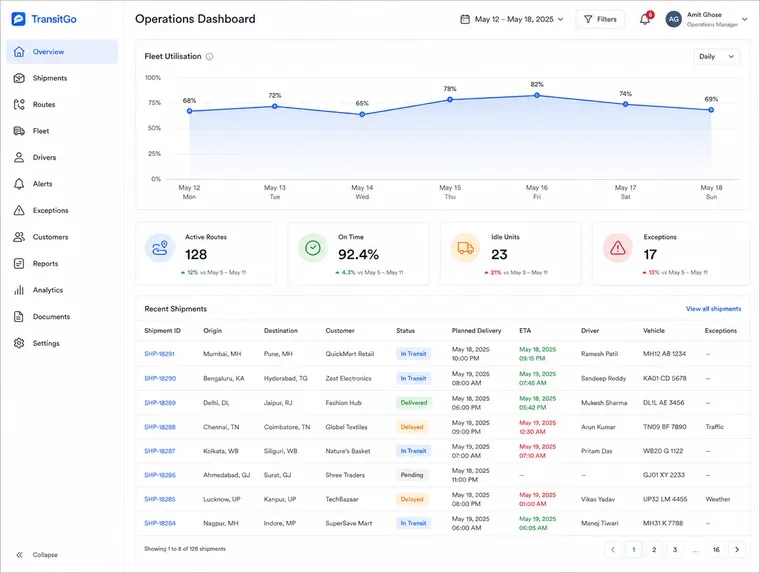
The brief we wrote back was narrower and harder: make the exceptions the centre of the product. A dispatcher does not need to see the four hundred shipments that are fine. They need the eleven that are not, ranked by how much trouble each one is about to cause.
The challenge
Operations software fails in a particular way. It is not that any single screen is bad. It is that the screens are built around the shape of the database rather than the shape of the day, so the operator has to reassemble the picture in their head every time they sit down.
Kestrel had this in an acute form. Shipment status lived in one table, carrier performance in another, and the relationship between them existed only in the experience of the three dispatchers who had been there longest. When one of them was on holiday, the operation measurably slowed, and nobody could say precisely why.
There was a second problem underneath it. The dispatchers did not trust the console's data, because it had been wrong before. Any redesign that simply presented the same data more attractively would have been ignored in the same way. Trust had to be rebuilt in the interface itself, by showing where a number came from and when it was last confirmed.
The third constraint was the hardest. Dispatchers work in long sessions under time pressure, often with a phone in one hand. Anything that required precision clicking, or that moved when they were not expecting it, would be abandoned within a week.
What we did
We started with the screen everyone had been avoiding: the exception queue. It is the screen the product is judged on, and it was the one nobody had designed. Getting it right set the standard for the rest.
We spent the first fortnight in the depot, watching dispatchers work rather than asking them what they wanted. What emerged was that the job is triage, not monitoring. The interface needed to be a queue, ordered by consequence, where the top item is always the thing to do next.
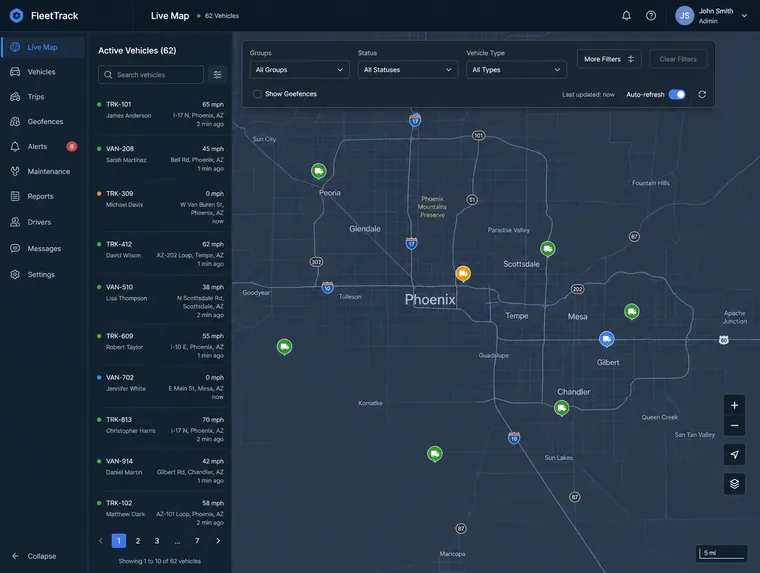
Everything else followed from that. Fleet tracking became a view you enter from an exception, not a map you browse. The dashboard stopped being a wall of charts and became four numbers a dispatcher could act on, each one clickable through to the rows behind it. Every figure carries the time it was last confirmed, in plain language, because a number without a timestamp is a number nobody believes.
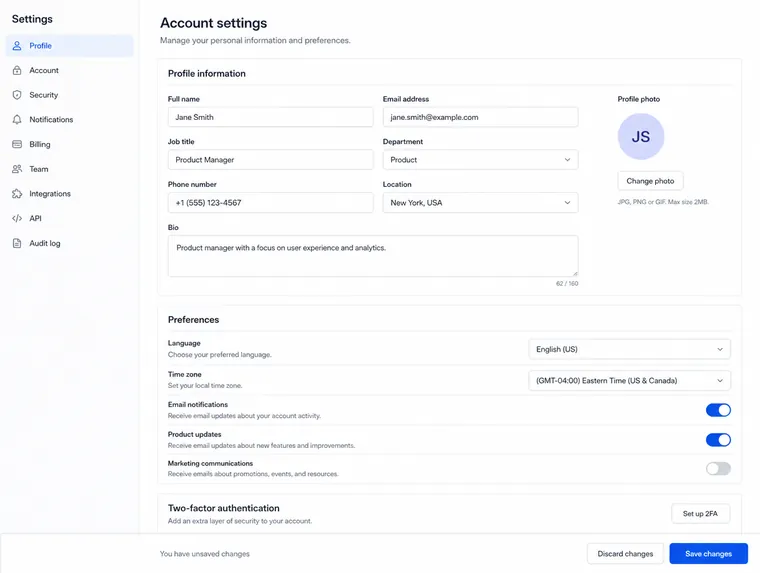
We built the design system alongside the screens rather than after them: a table that handles dense rows without becoming a spreadsheet, status treatments that read at a glance without relying on colour alone, and an empty state for every list that says what to do rather than apologising.
We wrote the production front end too. What Kestrel approved in review is what shipped, because the people who designed it built it, and nothing quietly degraded in the gap between a file and a browser.
The outcome
The console became the place the work happens rather than the place the work is recorded afterwards. The spreadsheets went out of use on their own, which is the only reliable sign that a tool has been adopted: nobody had to be told to stop.
The clearest result was not in the numbers Kestrel tracked but in what stopped being exceptional. Onboarding a new dispatcher stopped being an apprenticeship under one of the veterans. The knowledge that had lived in three people's heads was now expressed in the ordering of a queue, which meant a new starter could be useful in days rather than months.
The design system has since been extended by Kestrel's own team for two further internal tools without our involvement, which was the point. A system that only works while its authors are in the room is not a system, it is a style guide with better marketing.